
White Label Casino Platform: Your Ultimate Guide to Choosing


Launching an online casino in today’s competitive landscape requires strategic platform selection. The choice between a white label casino platform, a turnkey solution, or full custom development is pivotal, directly influencing your operational flexibility, time-to-market, and long-term profitability. For iGaming operators navigating the complexities of this rapidly evolving industry, understanding the nuances of each option is paramount.
This comprehensive guide, crafted by an iGaming expert, delves deep into the distinctions, advantages, and disadvantages of these three primary platform models. We aim to equip you with the insights needed to make an informed decision that aligns with your business goals, budget, and vision for success in the dynamic iGaming market.
Understanding the iGaming Platform Landscape
The global iGaming market is experiencing unprecedented growth, projected to exceed $150 billion by 2026, driven by technological advancements and increasing player engagement. For operators, this expansion presents both immense opportunities and significant challenges, particularly concerning the foundational technology that underpins their entire operation: the casino platform.
An iGaming platform is the technological backbone of any online casino, comprising the game engine, payment gateways, CRM, bonus systems, affiliate management, security infrastructure, and licensing framework. The decision on how to acquire this platform—whether through a shared, semi-independent, or entirely bespoke model—is one of the most critical strategic choices an operator will make.
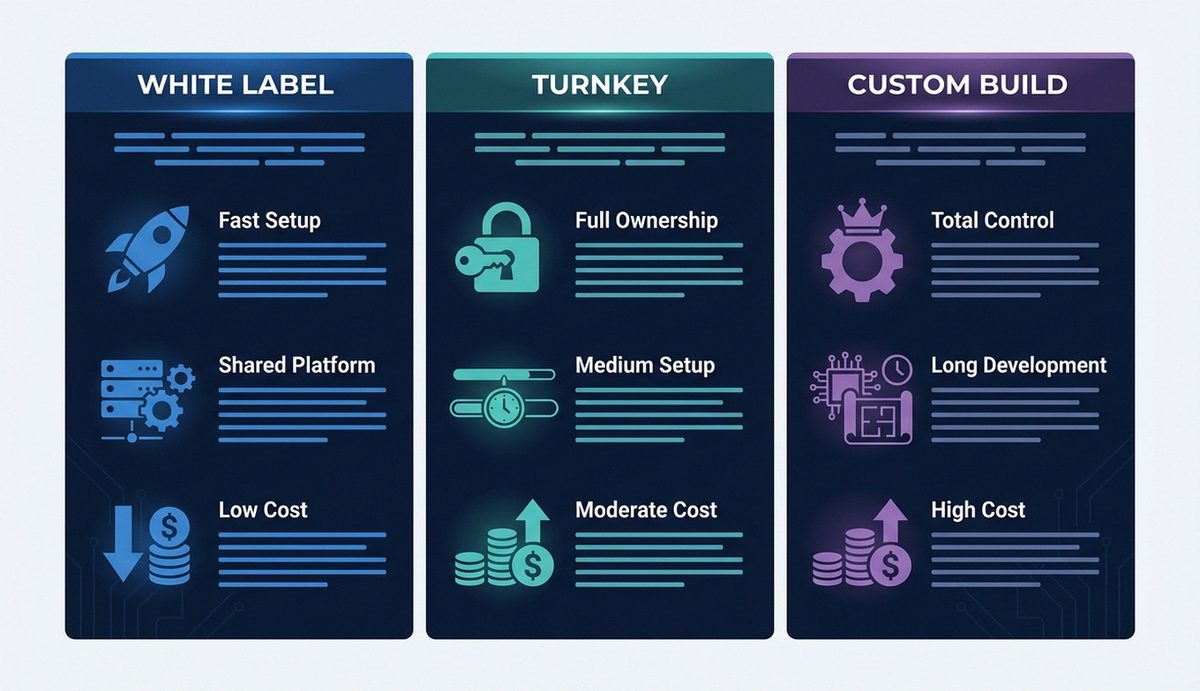
White Label Casino Platform Solutions
A white label casino platform represents the fastest and often most cost-effective entry into the iGaming market. In this model, an operator essentially leases a fully functional casino operation from an established provider. The provider supplies the license, games, payment systems, customer support, and even some marketing tools, allowing the operator to focus primarily on branding and player acquisition.
What is a White Label Casino Platform?
A white label solution means you receive a ready-to-launch casino website, branded with your logo and design, but operating under the provider’s existing gaming license. This significantly reduces the legal and regulatory burden on the operator. It’s a ‘plug-and-play’ model, ideal for those seeking minimal upfront investment and rapid deployment.
The provider manages most of the backend operations, including technical maintenance, compliance, and often even fraud prevention. This allows new entrants to leverage the provider’s established infrastructure and expertise without having to build it from scratch.
Pros and Cons of White Label
Advantages
- Fastest time-to-market (weeks/months)
- Lower initial setup costs
- No need for own gaming license
- Access to extensive game libraries
- Provider handles technical maintenance & support
- Reduced operational complexities
Disadvantages
- Limited control over core software & features
- Revenue share model (can be 25-40% of GGR)
- Shared license with other brands (potential reputation risks)
- Less brand differentiation & customization
- Reliance on provider’s payment systems & policies
- Scalability tied to provider’s infrastructure
Key Characteristics of White Label
When considering a white label casino platform, several characteristics stand out:
- Setup Costs & Revenue Share: Initial fees are relatively low (e.g., $20,000 – $100,000), but operators typically pay a significant revenue share to the provider (often 25-40% of Gross Gaming Revenue).
- Timeline to Launch: Remarkably fast, often within 2-4 months, as the infrastructure is already in place.
- Level of Control & Customization: Limited. Operators can brand the front-end, choose from available game providers, and manage marketing. Core platform features, payment solutions, and backend logic are fixed.
- Scalability: Generally good, as the provider’s infrastructure is built for multiple clients. However, specific feature requests for scaling might be limited.
When is White Label Best Suited?
A white label casino platform is the ideal choice for:
- New operators with limited capital and little to no prior iGaming experience.
- Entrepreneurs looking to test the market quickly with minimal risk.
- Businesses that want to focus solely on marketing and player acquisition.
- Companies that do not wish to obtain their own gaming license immediately.
Leading White Label Providers
Several prominent iGaming platform providers offer robust white label solutions. These include:
- SoftSwiss: Known for its extensive game aggregation, crypto solutions, and flexible white label packages.
- EveryMatrix: Offers a comprehensive suite of products, including a powerful white label casino platform with a vast content library.
- BetConstruct: Provides a wide range of iGaming products, including a customizable white label solution with sports betting and casino options.
- Gamingtec: Offers a full-service white label casino platform with a focus on fast deployment and strong technical support.
Turnkey Casino Solutions
A turnkey casino solution offers a middle ground between white label and custom development. While still providing a ready-made platform, it grants the operator more autonomy and control. With a turnkey solution, the provider delivers a complete, operational casino system, but the operator is typically responsible for obtaining and managing their own gaming license.
What is a Turnkey Casino Solution?
A turnkey solution provides a fully developed software platform, including game integrations, payment systems, and management tools. Unlike white label, you operate under your own gaming license, giving you greater regulatory control and brand independence. The provider handles the technical setup, integration, and ongoing maintenance of the software.
This model is ‘ready-to-go’ but allows for deeper customization than a white label, particularly in terms of branding, unique features, and selecting specific payment providers or game studios.
Pros and Cons of Turnkey
Advantages
- More control over branding & features
- Operator holds own gaming license
- Greater flexibility in payment & game providers
- Improved brand differentiation
- Potential for better revenue share terms (lower)
- Enhanced scalability options
Disadvantages
- Higher initial setup costs than white label
- Longer time-to-market than white label (3-6 months)
- Operator responsible for license acquisition & compliance
- Ongoing technical maintenance handled by provider
- Still some dependency on provider’s core platform
- Requires more operational involvement from operator
Key Characteristics of Turnkey
Understanding the key characteristics of a turnkey casino solution is vital for operators:
- Setup Costs & Revenue Share: Higher initial setup fees (e.g., $80,000 – $250,000) than white label, but often a lower revenue share (10-25% of GGR) or even a fixed monthly fee model.
- Timeline to Launch: Typically 3-6 months, factoring in license acquisition and more extensive customization.
- Level of Control & Customization: Significantly more control than white label. Operators can often integrate specific payment methods, tailor bonus systems, and heavily customize the user interface.
- Scalability: Excellent. Operators can often add new features, game providers, and scale infrastructure more independently, although still within the framework of the provided software.
When is a Turnkey Solution Best Suited?
A turnkey casino solution is ideal for:
- Operators with some iGaming experience or a strong team.
- Businesses seeking greater brand control and differentiation.
- Companies willing to obtain and manage their own gaming license.
- Operators with a medium-sized budget looking for a balance between speed and customization.
Prominent Turnkey Providers
Leading iGaming platform providers offering robust turnkey solutions include:
- EveryMatrix: Their CasinoEngine and GamMatrix platforms are strong examples of flexible turnkey offerings.
- SoftSwiss: Provides a highly customizable turnkey solution that allows operators to manage their own license and integrations.
- GammaStack: Known for delivering end-to-end turnkey casino and sports betting platforms with extensive customization options.
- Gamingtec: Offers a comprehensive turnkey solution, providing the software and support while the operator manages the license.
Custom Casino Development
Custom casino development represents the pinnacle of control, uniqueness, and long-term vision. This approach involves building an online casino platform entirely from scratch, tailored precisely to an operator’s specifications. It’s an intensive process, demanding significant investment in time and capital, but it offers unparalleled advantages in terms of brand identity, proprietary features, and scalability.
What is Custom Casino Development?
Custom development means designing, coding, and integrating every component of your iGaming platform from the ground up. This includes the gaming engine, backend management systems, front-end user interface, payment gateways, security protocols, and all third-party integrations. The result is a truly unique platform that perfectly embodies the operator’s vision and business model.
This option is for operators who have a distinct competitive edge in mind, require specific technologies, or aim to create an ecosystem that cannot be replicated by existing off-the-shelf solutions. It offers complete ownership and intellectual property rights over the software.
Pros and Cons of Custom Development
Advantages
- Complete control & limitless customization
- Unique brand identity & proprietary features
- Full ownership of intellectual property
- No revenue share, higher profit margins
- Maximum scalability & future-proofing
- Competitive advantage through innovation
Disadvantages
- Highest initial setup costs (millions)
- Longest time-to-market (12-24+ months)
- Requires in-house technical expertise or dedicated team
- Operator responsible for all maintenance & updates
- High ongoing operational & development costs
- Significant risk if not managed properly
Key Characteristics of Custom Development
For operators considering custom casino development, these characteristics are crucial:
- Setup Costs & Ongoing Maintenance: The highest initial investment, ranging from $500,000 to several million dollars, depending on complexity. Ongoing maintenance, development, and infrastructure costs are also substantial, as there’s no revenue share, but direct operational expenses.
- Timeline to Launch: The longest time-to-market, typically 12-24 months, sometimes even longer for highly complex projects.
- Level of Control & Customization: Absolute. Every aspect of the platform can be designed and developed to precise specifications.
- Scalability: Unmatched. The platform can be built with future growth, new technologies, and specific market expansions in mind from day one.
When is Custom Development Best Suited?
Custom casino development is best suited for:
- Large enterprises or established companies with significant capital and a long-term vision.
- Operators with a unique business model or proprietary gaming content.
- Companies seeking full control over their technology stack and intellectual property.
- Those aiming for maximum brand differentiation and a truly bespoke user experience.
Considerations for Custom Builds
Undertaking custom development requires careful planning. Operators must decide between building an in-house development team or outsourcing to specialized iGaming software development agencies. Both paths demand strong project management, deep technical understanding, and a clear vision of the final product. It’s a significant commitment, but one that can yield substantial competitive advantages and higher profit margins in the long run.
Comparative Analysis: White Label vs Turnkey vs Custom
The decision between a white label casino platform, a turnkey casino solution, and custom casino development hinges on a clear understanding of your business objectives, available resources, and risk appetite. Each model offers a distinct balance of speed, cost, control, and scalability. Operators must critically evaluate these factors against their strategic goals.
Decision-Making Factors
- Budget & Financial Model: Can you afford a large upfront investment for full ownership, or do you prefer lower initial costs with a revenue share?
- Time to Market: Do you need to launch in weeks, months, or are you planning for a multi-year development cycle?
- Brand Vision & Customization Needs: How unique does your brand need to be? Are standard templates sufficient, or do you require proprietary features?
- Operational Control & Autonomy: How much control do you want over licenses, payment systems, game providers, and technical infrastructure?
- Licensing & Regulatory Compliance: Are you prepared to obtain and manage your own gaming license, or do you prefer leveraging a provider’s existing one?
- Scalability & Future Growth: How do you envision your platform evolving? Will it need to integrate emerging technologies or expand into new markets rapidly?
Side-by-Side Comparison Table
| Feature | White Label Casino Platform | Turnkey Casino Solution | Custom Casino Development |
|---|---|---|---|
| Initial Cost | Low ($20K – $100K) | Medium ($80K – $250K) | High ($500K – $5M+) |
| Time to Market | 2-4 Months | 3-6 Months | 12-24+ Months |
| Control Level | Low (Branding only) | Medium (Branding, some features, own license) | High (Full control & ownership) |
| Revenue Share | High (25-40% GGR) | Medium/Low (10-25% GGR or fixed fee) | None (Direct operational costs) |
| Customization | Limited | Moderate to High | Unlimited |
| License | Provider’s License | Operator’s License | Operator’s License |
| Scalability | Good (within provider’s limits) | Very Good | Excellent (Built for future) |
| Responsibility | Marketing, Player Acquisition | Marketing, Operations, License | Full Development, Operations, License |
| Best For | New entrants, fast launch, low budget | Experienced operators, brand control, medium budget | Large enterprises, unique vision, high budget |
Practical Tips for Choosing Your iGaming Platform
Navigating the options for an online casino platform comparison can be daunting. As an iGaming expert, I recommend the following practical steps to ensure you select the best fit for your venture:
- Define Your Business Goals: Clearly articulate your target market, unique selling propositions, and long-term growth strategy. This clarity will guide your platform choice.
- Assess Your Budget and Resources: Be realistic about your upfront capital, ongoing operational budget, and the availability of in-house technical and operational expertise.
- Understand Regulatory Requirements: Research the specific licensing and compliance demands for your target jurisdictions. This heavily influences whether a shared license (white label) or your own license (turnkey/custom) is feasible.
- Evaluate Provider Reputation and Support: For white label and turnkey solutions, thoroughly vet potential igaming platform providers. Look for a track record of reliability, robust security, excellent customer support, and continuous platform development.
- Consider Future Expansion: Think about your five-year plan. Will your chosen platform support expansion into new markets, integration of new game types (e.g., live casino, sports betting), or adoption of emerging technologies like blockchain?
- Request Demos and References: Always ask for a demo of the platform and speak to existing clients of the provider to gauge their satisfaction and the platform’s real-world performance.
The right platform is not just a technology choice; it’s a strategic partnership that will define your success in the competitive iGaming industry. Take the time to make an informed decision.
Frequently Asked Questions
What is the primary difference between a white label and a turnkey casino solution?
The primary difference lies in licensing and control. A white label casino platform operates under the provider’s gaming license, offering less control but faster market entry. A turnkey casino solution requires the operator to obtain their own gaming license, granting greater control over operations, branding, and payment solutions.
How much does a white label casino platform typically cost to set up?
A white label casino platform generally has the lowest setup cost, typically ranging from $20,000 to $100,000. However, this model usually involves a significant revenue share with the provider, often between 25-40% of Gross Gaming Revenue.
What is the average time-to-market for a custom casino development?
Custom casino development has the longest time-to-market, usually taking between 12 to 24 months, or even longer for highly complex projects. This duration accounts for design, development, integration, testing, and obtaining necessary licenses.
Which option offers the most control over game selection and payment providers?
Custom casino development offers the most control, allowing operators to integrate any game providers or payment solutions they choose. A turnkey casino solution offers significant control, while a white label casino platform has limited options, restricted to the provider’s existing integrations.
Is a white label solution suitable for experienced iGaming operators?
While a white label casino platform is primarily for new entrants, experienced operators might use it for niche markets or quick expansion with minimal risk. However, for core operations or unique branding, experienced operators typically prefer a turnkey casino solution or custom casino development due to greater control.
What are the key benefits of owning my own gaming license with a turnkey solution?
Owning your own gaming license with a turnkey casino solution offers greater regulatory independence, allows for more tailored payment processing, enhances brand reputation, and provides more flexibility for future market expansion without being tied to a provider’s license jurisdiction.
Can I integrate unique features or proprietary games with a turnkey casino solution?
Yes, a turnkey casino solution generally allows for moderate to high customization, including integrating unique features or proprietary games, although it might involve additional development costs and time. This is a significant advantage over a standard white label casino platform.
When should an operator consider full custom casino development?
Operators should consider custom casino development if they have a substantial budget, a long-term strategic vision, a unique business model that cannot be fulfilled by existing solutions, and a strong desire for complete control over intellectual property, features, and user experience.
Which iGaming platform providers are known for offering comprehensive solutions?
Prominent iGaming platform providers known for comprehensive solutions across white label, turnkey, and even custom support include SoftSwiss, EveryMatrix, BetConstruct, and Gamingtec. These providers offer a range of services to suit different operator needs.
How does the revenue model differ between white label and custom development?
With a white label casino platform, operators pay a significant percentage of their Gross Gaming Revenue (25-40%) to the provider. In contrast, with custom casino development, there is no revenue share; operators bear all initial development costs and ongoing operational expenses, resulting in 100% ownership of profits.
Choosing the right online casino platform is a foundational decision that will shape your entire iGaming venture. Whether you opt for the rapid deployment and lower entry barriers of a white label casino platform, the balanced control and independence of a turnkey casino solution, or the unparalleled customization and ownership of custom casino development, your choice must align perfectly with your strategic objectives, financial capabilities, and long-term vision.
The iGaming market, projected to continue its robust growth through 2026, rewards informed decisions and strategic partnerships. By thoroughly evaluating the setup costs, timelines, control levels, revenue implications, and scalability of each option, you can confidently select the platform that will propel your online casino to success. For tailored advice and to explore which solution best fits your unique aspirations, contact an experienced iGaming consultant today.