
How to Start an Online Casino Business: A Comprehensive Step-by-Step Guide


Embarking on the journey of how to start an online casino is an ambitious yet highly rewarding venture in today’s dynamic iGaming landscape. As an experienced B2B iGaming consultant, we understand the complexities and opportunities inherent in building a successful digital casino from the ground up. This comprehensive guide provides a detailed roadmap for entrepreneurs and investors looking to launch an online casino, covering every critical step from initial concept to post-launch optimization.
The iGaming industry continues to expand globally, driven by technological advancements and evolving player preferences. However, success is not guaranteed; it demands meticulous planning, significant investment, and a deep understanding of regulatory frameworks. Our aim is to equip you with the knowledge and practical advice needed to navigate this intricate process effectively, ensuring your online casino startup guide is robust and actionable.
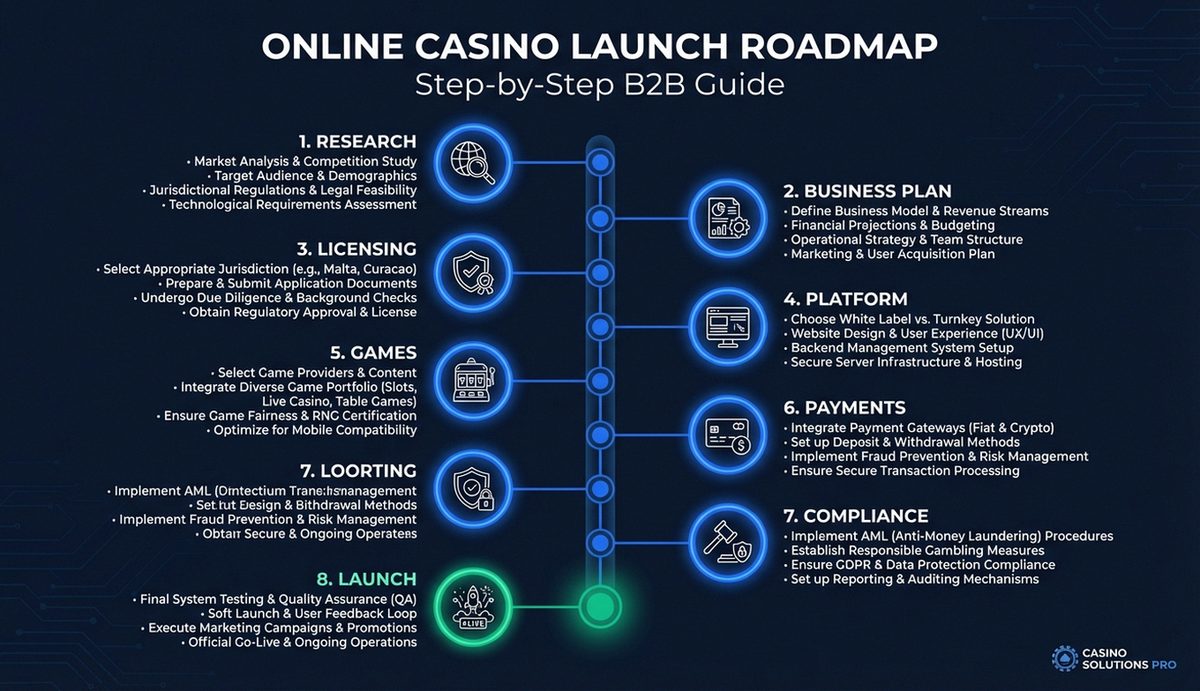
Phase 1: Market Research and Niche Identification
Before you can successfully launch an online casino, thorough market research is paramount. Understanding the landscape, identifying your target audience, and analyzing competitors will lay the foundation for a sustainable business model. This initial phase helps define your unique selling proposition (USP) and informs every subsequent decision.
Identifying Your Target Audience
Who are you trying to attract? This question is central to your strategy. Research demographics, psychographics, preferred game types, and spending habits of potential players. Consider geographical regions where online gambling is legal and popular, as this will heavily influence your licensing and marketing efforts. Do you target high rollers, casual players, or a specific niche like esports betting enthusiasts?
Understanding cultural nuances and language preferences is also crucial. A casino tailored to European players might differ significantly from one targeting Asian markets. Detailed player profiles will guide your game selection, marketing messages, and even your website’s design. This foundational step is critical when you start an online casino.
Competitor Analysis
Analyze existing online casinos, both direct and indirect competitors. What are their strengths and weaknesses? What kind of bonuses do they offer? Which software providers do they use? Examine their marketing strategies, customer support quality, and user experience. Look for gaps in the market or areas where you can offer a superior service.
Identify successful features you can emulate and common pitfalls you should avoid. This analysis will help you differentiate your offering and carve out a unique space. A thorough understanding of the competitive landscape is essential for any aspiring online casino startup guide.
Jurisdictional Opportunities and Restrictions
The legal landscape for online gambling varies dramatically by country and region. Some markets are highly regulated (e.g., UK, Malta, Sweden), while others are less restrictive or even outright prohibited. Your market research must include a deep dive into potential jurisdictions where you plan to operate.
This will determine the type of license you need, the compliance requirements, and the potential player base you can access. Focusing on regions with clear regulatory frameworks can mitigate legal risks and provide a stable operating environment for your online casino.
Phase 2: Crafting Your Comprehensive Business Plan
A robust business plan is the blueprint for your online casino. It outlines your vision, strategy, operational details, and financial projections, serving as a critical document for securing funding and guiding your team. This plan will evolve, but its initial structure is vital for anyone serious about how to start an online casino.
Executive Summary and Company Overview
Provide a concise overview of your entire business plan, highlighting your mission, vision, and key objectives. Describe your company’s structure, management team, and the unique value proposition of your online casino. This section should immediately capture the reader’s attention and convey the viability of your venture.
Operational and Financial Projections
Detail your operational model, including customer support, fraud prevention, and technical infrastructure. Crucially, this section must include comprehensive financial projections: startup costs, operational expenses, revenue forecasts, and break-even analysis. Be realistic and account for licensing fees, platform development, game content, marketing, and staffing.
Startup costs for a basic white-label solution can range from €100,000 to €300,000, while a custom platform can easily exceed €500,000 to €1,000,000+. Operational costs, including salaries, marketing, and software maintenance, can be €30,000 – €100,000+ per month. Timelines for reaching profitability typically range from 18-36 months.
Marketing Strategy Outline
Sketch out your initial marketing and acquisition strategies. How will you attract players? Consider channels like affiliate marketing, SEO, social media, content marketing, and paid advertising. Outline your branding, messaging, and promotional offers. A well-defined marketing approach is crucial for player acquisition and retention, forming a core part of your online casino startup guide.
Phase 3: Navigating the Licensing Landscape
Obtaining a gambling license is arguably the most critical and complex step when you launch an online casino. It legitimizes your operation, builds player trust, and allows you to operate legally in specific jurisdictions. The choice of license dictates your market access and regulatory obligations.
Key Jurisdictions and License Types
Popular licensing jurisdictions include:
- Malta Gaming Authority (MGA): Highly reputable, offers access to various European markets. Costs range from €25,000 – €50,000 for application and annual fees, with a timeline of 6-12 months.
- Curacao eGaming: More affordable and quicker to obtain, often used as a starting point. Costs around €20,000 – €40,000 for setup and annual fees, with a timeline of 2-6 months.
- UK Gambling Commission (UKGC): Extremely stringent, grants access to the lucrative UK market. High costs, often £50,000 – £100,000+ for application and annual fees, with a timeline of 12-18 months.
- Gibraltar, Isle of Man, Kahnawake: Other reputable options with varying requirements and market access.
Each license comes with specific requirements regarding financial stability, responsible gaming measures, anti-money laundering (AML) protocols, and technical standards. This is a fundamental aspect of how to start an an online casino responsibly.
Application Process and Requirements
The application process involves extensive documentation, including personal declarations for all key individuals (shareholders, directors), proof of funds, detailed business plans, software audits, and robust AML/KYC policies. Expect rigorous due diligence from regulatory bodies. Legal and compliance experts are indispensable during this phase to ensure all requirements are met.
Costs and Timelines
Beyond application fees, consider legal consultation fees (€10,000 – €50,000+), compliance audits, and ongoing regulatory costs. The timeline for obtaining a license can vary significantly, from a few months for Curacao to over a year for more demanding licenses like the UKGC or MGA. Plan for these delays and costs in your initial budget when you decide to launch an online casino.
Phase 4: Platform Selection and Development
The technological backbone of your online casino is its platform. Choosing the right solution is crucial for performance, scalability, security, and user experience. This decision significantly impacts your development timeline and budget.
White Label vs. Turnkey vs. Custom Solutions
- White Label: The quickest and most cost-effective option. You operate under the provider’s existing license and platform, branded with your look and feel. Ideal for those who want to start an online casino quickly. Costs: €50,000 – €150,000 setup, plus revenue share. Timeline: 1-3 months.
- Turnkey: You get a complete, ready-to-use platform, but you need to obtain your own license. Offers more control than white label. Costs: €150,000 – €300,000 setup, plus monthly fees. Timeline: 3-6 months (platform), plus license time.
- Custom Development: Building a platform from scratch offers maximum flexibility and uniqueness but is the most expensive and time-consuming. Costs: €500,000 – €1,500,000+. Timeline: 12-24 months.
Key Platform Features
Your platform must include a robust backend for game management, player management (CRM), bonus systems, payment integration, reporting, and security. On the frontend, focus on intuitive navigation, mobile responsiveness, and an engaging user interface (UI) and user experience (UX). Features like multi-language support, responsible gaming tools, and a powerful content management system (CMS) are also essential for your online casino startup guide.
Scalability and Technology Stack
Ensure the chosen platform can handle future growth in terms of player volume and game content. A scalable infrastructure prevents performance issues as your casino expands. The technology stack should be modern, secure, and supported by a reliable development team. Discuss uptime guarantees, disaster recovery plans, and continuous integration/continuous deployment (CI/CD) practices with your provider.
Phase 5: Game Content Integration
The games are the heart of any online casino. A diverse and high-quality game library is crucial for attracting and retaining players. Partnering with reputable game providers is key to delivering an engaging experience.
Choosing Game Providers
Integrate games from leading providers such as NetEnt, Microgaming, Play’n GO, Evolution Gaming (for live casino), Pragmatic Play, and many others. A good mix includes slots, table games (blackjack, roulette, baccarat), video poker, and live dealer games. Many platforms offer API integrations with multiple providers, streamlining the process.
Consider the reputation of the providers, the fairness of their games (RTP – Return to Player), and their certification by independent auditors. This ensures trust and compliance for your online casino.
Variety and Player Experience
Offer a wide variety of games to cater to different player preferences. Regularly update your game library with new releases to keep players engaged. Focus on games with high-quality graphics, immersive sound, and engaging gameplay mechanics. User-friendly interfaces and clear instructions are also vital for a positive player experience.
RTP and Fairness
Ensure all games are fair and their Random Number Generators (RNGs) are certified by independent testing agencies like eCOGRA or iTech Labs. Transparently display RTP percentages where legally required. This builds player trust and is a regulatory necessity for any legitimate online casino.
Phase 6: Payment Processing and Financial Infrastructure
Efficient and secure payment processing is fundamental for any online casino. Players need reliable methods to deposit and withdraw funds, and your business needs robust systems to manage these transactions and prevent fraud.
Secure Payment Gateways
Integrate a range of popular and secure payment methods, including credit/debit cards (Visa, Mastercard), e-wallets (Skrill, Neteller, PayPal), bank transfers, and local payment solutions specific to your target markets. Ensure all transactions are encrypted using SSL technology and comply with PCI DSS standards. A reliable payment gateway is non-negotiable when you start an online casino.
Cryptocurrency Integration
Consider integrating cryptocurrency payment options (Bitcoin, Ethereum, Litecoin, etc.) to cater to a growing segment of players who prefer digital currencies for their speed, lower fees, and anonymity. This can also open up new markets and demographics for your online casino.
Fraud Prevention and Risk Management
Implement advanced fraud detection systems and risk management tools to protect both your business and your players. This includes monitoring for suspicious activity, verifying identities, and setting transaction limits. Partner with reputable fraud prevention providers to safeguard your financial operations. This is a critical component of any online casino startup guide.
Phase 7: Compliance, Security, and KYC Setup
Operating a legal and ethical online casino requires strict adherence to regulatory compliance, robust security measures, and effective Know Your Customer (KYC) procedures. These elements protect your business from legal issues and build player confidence.
AML and Responsible Gaming
Develop and implement comprehensive Anti-Money Laundering (AML) policies to detect and prevent illicit financial activities. This includes reporting suspicious transactions to relevant authorities. Additionally, integrate responsible gaming tools such as deposit limits, self-exclusion options, and reality checks to protect vulnerable players. This commitment to responsible gaming is often a licensing requirement and demonstrates your ethical approach to running an online casino.
Data Security and Privacy (GDPR, etc.)
Protect player data with state-of-the-art security measures, including firewalls, intrusion detection systems, and regular security audits. Comply with data protection regulations such as GDPR (General Data Protection Regulation) in Europe and similar laws globally. Transparency about data handling practices builds trust and avoids hefty fines.
KYC/KYB Procedures
Implement robust Know Your Customer (KYC) and Know Your Business (KYB) procedures to verify the identity of your players and business partners. This typically involves collecting identity documents, proof of address, and sometimes source of funds. KYC helps prevent fraud, underage gambling, and money laundering, making it an indispensable part of how to start an online casino securely.
Phase 8: Developing a Robust Marketing Strategy
Once your online casino is built and licensed, a powerful marketing strategy is essential to attract players and establish your brand in a competitive market. This requires a multi-faceted approach.
Affiliate Marketing
Partner with iGaming affiliates who promote your casino to their audience in exchange for a commission (CPA, revenue share). This is a highly effective channel for player acquisition. Building strong relationships with reputable affiliates is key to a successful launch online casino strategy.
SEO and Content Marketing
Optimize your website for search engines to rank high for relevant keywords. Create engaging content like game reviews, guides on how to play casino games, and blog posts about responsible gambling. This organic traffic is highly valuable and sustainable. Regular content updates are vital for your online casino startup guide.
Social Media and PR
Establish a strong presence on social media platforms relevant to your target audience. Engage with players, run promotions, and build a community. Utilize public relations to generate positive media coverage and build brand awareness for your new online casino.
Retention Strategies and CRM
Attracting players is one thing; keeping them is another. Implement CRM (Customer Relationship Management) strategies to nurture player loyalty through personalized bonuses, loyalty programs, VIP schemes, and excellent customer support. Email marketing and push notifications can also be effective tools for retention.
Phase 9: The Launch Checklist and Post-Launch Optimization
The final stages involve meticulous testing and a strategic launch, followed by continuous monitoring and improvement. This ensures a smooth debut and sustained growth for your online casino.
Pre-Launch Testing and Quality Assurance
Before going live, conduct extensive testing of every aspect of your online casino: games, payment systems, bonus mechanics, customer support channels, and mobile responsiveness. Bug testing, penetration testing, and user acceptance testing (UAT) are crucial to ensure a flawless player experience. A comprehensive pre-launch check is non-negotiable when you want to launch an online casino.
Grand Opening Strategy
Plan your official launch with a bang! This might involve special introductory bonuses, a press release, or a targeted marketing campaign. Ensure your customer support team is fully trained and ready to handle initial player inquiries. Monitor website traffic and server performance closely during the first few days.
Continuous Monitoring and Improvement
The work doesn’t stop after launch. Continuously monitor key performance indicators (KPIs) such as player acquisition cost (CAC), player lifetime value (LTV), conversion rates, and average revenue per user (ARPU). Gather player feedback and use data analytics to identify areas for improvement. Regular software updates, game additions, and marketing adjustments are vital for long-term success and to sustain your online casino startup guide.
Frequently Asked Questions
How much does it cost to start an online casino?
The cost to start an online casino varies significantly. A white-label solution can range from €50,000 to €150,000 for setup, plus ongoing fees. A turnkey solution might be €150,000 – €300,000, while a custom-built platform can exceed €500,000 to €1,500,000+. These figures exclude marketing, operational costs, and licensing fees, which can add substantial amounts.
How long does it take to launch an online casino?
The timeline to launch an online casino depends on the chosen platform and licensing jurisdiction. A white-label casino can be ready in 1-3 months. A turnkey solution, plus license acquisition, may take 6-12 months. A custom-developed casino, including a license, can take 12-24 months or even longer.
What kind of license do I need to start an online casino?
You need an iGaming license from a reputable jurisdiction. Common options include Malta (MGA), Curacao eGaming, UK Gambling Commission (UKGC), Gibraltar, and Isle of Man. The best license for you depends on your target markets and budget, as each has different requirements, costs, and market access.
Is it profitable to start an online casino?
Yes, starting an online casino can be highly profitable, but it requires substantial investment, meticulous planning, and effective execution. Profitability typically takes 18-36 months to achieve, with ongoing efforts in marketing, player retention, and compliance being crucial for long-term success.
What are the most important features for an online casino platform?
Key features for an online casino platform include a robust backend (game management, player CRM, bonus system, reporting), secure payment gateway integration, a diverse game library, strong security protocols, mobile responsiveness, and responsible gaming tools. A user-friendly interface is also critical for player experience.
How do I attract players to my new online casino?
Attracting players requires a multi-channel marketing strategy. This typically includes affiliate marketing, search engine optimization (SEO), content marketing, social media engagement, paid advertising, and public relations. Offering attractive welcome bonuses and loyalty programs is also essential.
What are the biggest challenges when trying to launch an online casino?
The biggest challenges include navigating complex regulatory and licensing requirements, securing significant startup capital, building a reliable and scalable technical platform, integrating diverse game content and payment solutions, and developing effective marketing strategies in a highly competitive market.
Do I need a custom platform or can I use a white-label solution?
The choice between a custom platform and a white-label solution depends on your budget, timeline, and desired level of control. A white-label is quicker and cheaper, operating under an existing license. A custom platform offers maximum flexibility and uniqueness but is more expensive and time-consuming. A turnkey solution provides a middle ground.
What is KYC and why is it important for an online casino?
KYC (Know Your Customer) refers to the process of verifying the identity of your players. It’s crucial for online casinos to prevent fraud, money laundering, and underage gambling. Regulators mandate KYC procedures to ensure compliance and maintain the integrity of the iGaming industry.
How do I ensure my online casino is compliant with responsible gaming regulations?
To ensure compliance, integrate responsible gaming tools directly into your platform, such as deposit limits, loss limits, self-exclusion options, and reality checks. Provide clear information on problem gambling resources and train your staff to identify and assist players at risk. Adherence to these measures is often a core requirement for your gambling license.
The journey of how to start an online casino is undoubtedly challenging, demanding significant investment, strategic foresight, and unwavering commitment to regulatory compliance. However, with the right approach and expert guidance, it presents an unparalleled opportunity to enter a booming global market. This comprehensive online casino startup guide has outlined the essential phases, from initial market research and robust business planning to platform selection, licensing, game integration, and sophisticated marketing strategies.
Remember, success in the iGaming sector is built on a foundation of trust, security, and an exceptional player experience. By meticulously following these steps and partnering with experienced professionals, you can confidently launch an online casino that stands out in the competitive landscape. If you’re ready to take the next step and transform your vision into a thriving iGaming business, consult with industry experts to ensure a smooth and successful launch online casino venture.